
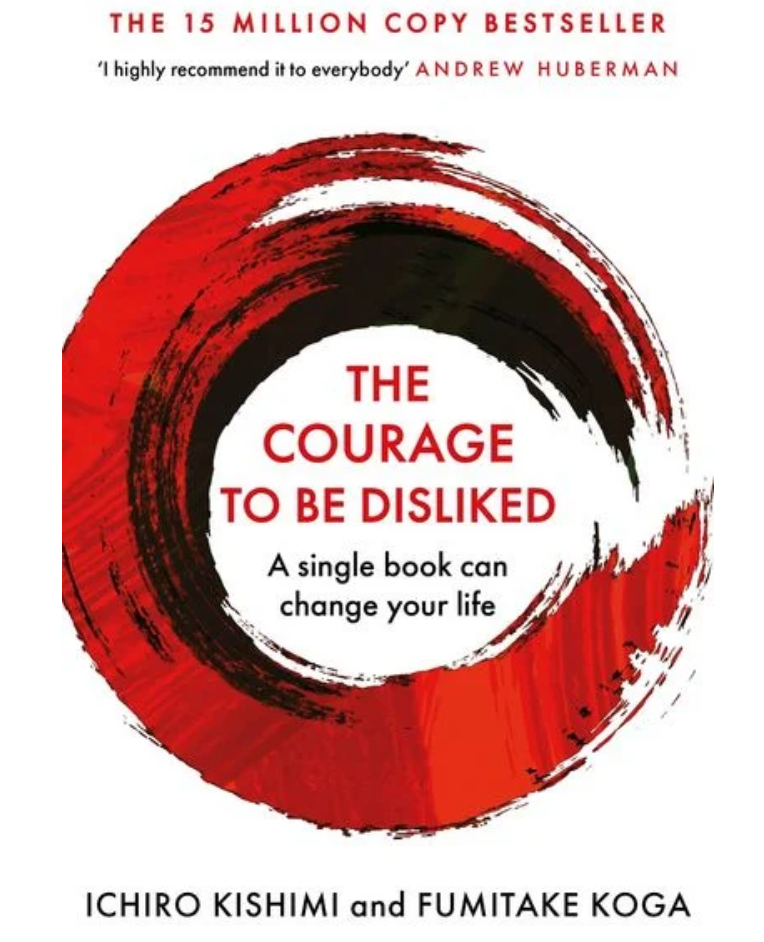
I recently read the book The Courage to be Disliked by Ichiro Kishimi and Fumitake Koga. It was recommended to me by my daughter, who also recently read it. It is a book which is a combination of psychology and philosophy. It is structured as a Socratic dialogue between a young person and an older philosopher. Ever since I read it, it has been deep in my mind, causing me to rethink many of my life’s decisions and how I go about seeing the world. I don’t agree with everything in the book, but I did find that it has some very strong concepts. In particular, I think the idea that everyone can be happy, regardless of what has happened in the past, really struck me. The book is based on the psychology of Alfred Adler, who was a contemporary of Sigmund Freud, but whose ideas diverge substantially from those of Freud. In Freudian psychology, one’s current situation is treated as a cause effect relationship based on the past. A classic example is that your therapist tells you that you are unhappy because you had a bad childhood. Adler throws this cause and effect relationship on its head. Instead, he says that the present day is like it is because that’s how you want it to be; if you are unhappy, then you find ways to justify why you are unhappy. For example, that you had a bad childhood. When I mentioned this to my friend Katja, her first reaction was “wow, that sounds like victim blaming”. Yes, one could take it that way. However, I don’t think it has to be that way. For me it has been very freeing. The last year has been very tough for me. I have spent a lot of time rehashing the decisions that I’ve made, often with regret. This has not made me happy. In fact, it has made me very unhappy. And in many ways, I think I have felt somewhat helpless. But after reading this book suddenly I feel empowered to make my life the way I want, to reconstruct my future. I have the power to be happy. I just have to figure out first of all what is it that actually makes me happy. That is one thing that actually I don’t know that I’ve spent that much time deeply thinking about in my life, and now I am thinking about it more.
There are several other very important concepts in the book which I want to address. The authors argue that based on Adlers psychology, all problems in life have to do with interpersonal relationships. That is a bold claim. To go along with that, the way to fix interpersonal relationships has to do with the separation of tasks. Adler argues that I have my tasks and that you have your tasks and that I should not try to do your tasks or the tasks of other people. When I try to do other people’s tasks, it leads to problems. I think there is something to be said about this idea. I am not certain that it always applies, but I can definitely understand the logic. In particular, it goes along very well with the well-known serenity prayer
God, grant me the serenity to accept the things I cannot change, the courage to change the things I can, and the wisdom to know the difference.
Reinhold Niebuhr
It doesn’t do much good to sit around and worry about things what you have no control over. It does make sense to worry about things that you do have control over. Actually not so much worry, but rather anticipate and plan. For example, if one looks at the weather forecast, and it is going to rain, then one can bring an umbrella to be prepared for it. One does not have control over the weather, but one does have control over one’s clothing. To go along with this idea he also talks about the expectations of others, and this is where the title of the book comes in to play: the courage to be disliked. The authors say that you should never do something in the hopes that somebody else might like it. There’s no way that I can control whether or not someone else is going to like what I do. That is their task; it is not my task. Therefore, I should not do things in the hopes that it will make other people happy. But here is where it gets complicated. Near the end of the book, they also mention that the most important thing in life is to be useful to others. So how can one know if one is being useful to others without getting feedback from others? That is a part of the book that I am still confused about and working through in my mind.
There was one part of the book in which I definitely disagree. At some point, he commented that people should not think of life as being some sort of line that one can draw. Instead, he argues that it has a series of points. Each point represents a specific instance in time. And each instance in time is separate from one another. As a data scientist, I strongly disagree with this. While it is true that our lives are made of individual occurrences, it is very possible and easy to find patterns in these individual occurrences which can be represented as lines. It may be a linear relationship or maybe polynomial or exponential and it may change over the course of your life. As you zoom in and zoom out of all the different periods of your life, you can find different patterns. This is a lot of the way that I think as someone who is data-driven. Or at least data-informed. I agree that it is not a good idea to spend too much time hashing about the past because that is something that we have no control over. We cannot change the past. However, if we look at all of these individual occurrences in the past through the lens of a data scientist, we can find patterns from which we can learn. It is worthwhile to think retrospectively in order to make better decisions in the future. Learning from one’s mistakes is crucial in order to improve oneself. I won’t go into detail here because I have already blogged about one of experience in my life in which I successfully learned from other people’s mistakes. That is even better than learning from your own mistakes.
Another philosopher who has had a very strong influence in my life is Jean-Paul Sartre. He was an atheist existentialist. In the readings that I have done from him, he never argued about the presence or the existence or nonexistence of God, but rather just assumed that God does not exist. When one assumes that there is no creator then that creates a conundrum. Consider for example a pencil. Someone created that pencil with a particular purpose in mind. The pencil knows why it exists. But if there is no God, if there is no creator, then humans have no inherent purpose in life. Rather, it is our job to figure out the meaning of life, our purpose, for ourselves. With this comes with both great freedom, but also great responsibility and can feel daunting. For me personally, I have always felt that the meaning of life is to try to leave the world a little bit better than the way that I was brought into it. That philosophy has shaped many of the decisions that I have made over the years and that I continue to make. For example, it is one of the reasons why I am a firm believer in trying to protect the environment for future generations. It is one of the reasons why I believe in social justice. It is one of the reasons why I decided to have children, under the assumption that I have been blessed with good genes and resources and that I could hopefully pass those on to another generation.
For me, the idea of making the world a better place and the idea of being useful to others go hand-in-hand. But, it can also get complicated. For example, sometimes I might do something which I think is being useful to others, but then I later learned that the people for whom I was doing this didn’t actually want me to do that. How should I act in these situations? Should I ask people first if they want me to do something? That reminds me a little bit of gifting. In the culture that I am familiar with, there are certain occasions, such as birthdays, in which it is common to give gifts. Usually one does not disclose the gift ahead of time. It is a surprise. Many people seem to enjoy that surprise. It’s true that not all gifts are great. But I really do feel like often. The best gifts that I ever received our gifts that I wouldn’t have thought to ask of myself. Usually those gifts come from someone who knows me quite well. Not always, but usually. My wife tells me that she doesn’t like surprises, not even for gifts. That is true to some extent. However, I have definitely given her gifts which she did not ask for and has enjoyed. Personally, I have particularly enjoyed getting gifts of kitchen utensils because whenever I use them, I always think about the person who gave it to me.
Another concept which is discussed in the book is that of the difference between vertical and horizontal relationships. A vertical relationship is any sort of relationship where there is a power dynamic. For example, an employee and a boss, or a parent and child. Adler says that we should avoid vertical relationships. In theory, I think that is probably good. However, in practice, I think it is not always feasible. And even in theory, I disagree some that parents and children should be seen in a horizontal relationship. Adler argues that parents should neither praise nor scold their children. That is a very bold claim. I understand the logic. He argues that when one praises a child that one is introducing a vertical relationship. If I tell my child that they did a good job it is putting me in the position where I am the judge of what is good or bad. The same goes if I tell them, they did a bad job. Again, I am the judge, and that puts us in a vertical relationship instead of a horizontal relationship. It also goes along with the idea that one should not do anything just to believe others. The child should not do well in school in order to get praise from the parents. It is the child’s task to do homework. It is not the parent task to force the child to do their homework. I am not so certain about this. Especially when I think about very young children. I think that as children age it is part of the responsibility of parents to help a child figure out what is their tasks and to take on responsibility for themselves so that when they become adults, they can be self-sufficient and independent. However, that is a long task, usually taking around 18 years or maybe even more. So that is one area where I am not certain that I will ever agree with either. However, it has caused me to reevaluate some of those relationships and my the way that I interact with my children.
I’m not writing this on my blog because I hope that someone will like it. I am writing it to help me process the thoughts for myself. I read sometime in the last several years that in order to fully understand a text one needs to write about it. That makes total sense to me. It goes along with the old adage that the best way to learn something is to teach it. I have experienced that myself as well. There are many things that I know that I can well, do but until I try to teach that to someone else, I frequently have not done the self-examination of exactly how I do it myself. Some people say that just because you are good at doing something doesn’t mean that you are good at teaching it. In fact, many times people who are particularly good at one skill might be very poor at teaching it precisely because they are not capable of comprehending what it would be like to not be good at that skill. If something has always come easy to you, you can’t understand the struggle. On the other hand, if you had to work hard and struggle to learn something, then you are more likely to be able to teach others who might also be struggling in the same ways. So right now, I am struggling. I am wrestling with these new thoughts. I am grappling. I am contemplating. What is it that makes me happy in life? What am I looking to get out of life? How can I be useful to others? What are my tasks? These are not easy questions to answer and I might be grappling with these for the rest of my life. However, I truly feel after reading this book a new sense of optimism which I have not felt in over a year. I feel a new sense of ownership over my future. I can be happy. Even if bad things have happened in the past, even if I have made mistakes, which I surely have. I can foresee a bright future for myself.
While I’m not asking for you to like this post as I’ve already mentioned, I would find it interesting to discuss these ideas with other people. So if you have read the book, I would be very interested to hear your ideas on it. Even if you haven’t read the book, I would be interested to hear what you think about my synopsis.
One response to “The courage to be disliked”
Hey Rob, I read your synopsis but not the book itself. Still, I think you do a great job explaining both the book and Alfred Adler’s psychology. If you’re not already aware, I’d say this is pretty much Stoicism—with a few additional elements. I’m a passionate reader of the ancient Stoics, and learning about them greatly impacted my life, especially their idea of remaining calm amid chaos. They emphasize focusing on what you can control and accepting what’s beyond your reach. Also, according to Google, Reinhold Niebuhr’s quote is actually inspired by his Stoic thoughts. Great post! Keep up the cool blogging!